
In this essay, I will briefly discuss the idea behind getting children to learn to code and what it means in terms of competencies required to thrive in today’s world.
The idea that computers might be extremely conducive to developing the thinking skills of children was first put forward by Seymour Papert, a computer scientist, mathematician, and educator, and the pioneer of the constructionist learning theory.
Papert used the term “constructionism” to describe a learning theory that emphasizes hands-on, experiential learning through participation in personally meaningful projects (Resnick et al., 1988). He believed that learners construct knowledge and understanding by actively engaging in the process of building and creating things. According to Papert, constructing something external, such as a computer program or physical object, helps learners develop a deeper understanding of the underlying concepts and fosters their creativity.
It is on these lines that Papert created programs such as Logo 1.0, Logo 2.0, and LEGO/Logo. Logo is essentially a programming language designed for children. In this program, there is an on-screen turtle that can be moved forward or backward through an inputted number of steps.
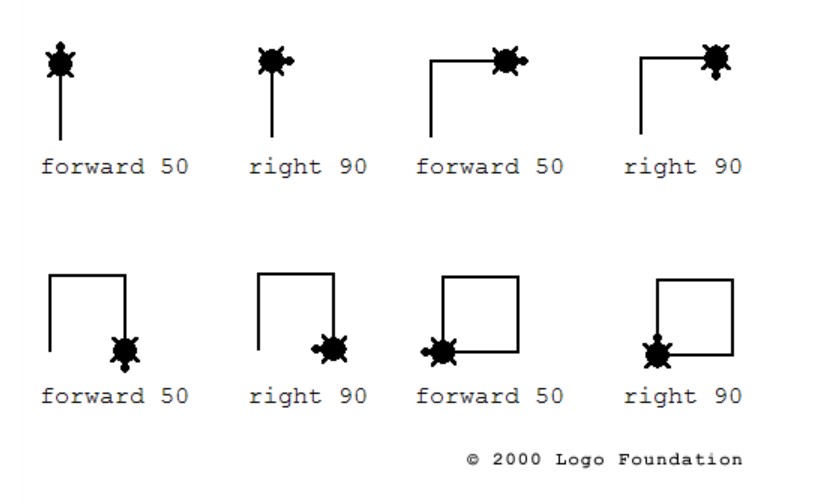
Papert’s influential book “Mindstorms: Children, Computers, and Powerful Ideas” (1980) outlined his vision for using computers as tools for creative exploration and intellectual development. He argued that computers could act as “mind tools” that empower children to think, learn, and problem-solve in new and meaningful ways, leading to computational thinking skills (Papert, 1980).
Papert placed a key importance on learning in meaningful contexts that are personally significant and engaging to students (Higginson, 2017). He believed that education should connect with students’ interests, passions, and cultural backgrounds. By incorporating real-world problems into the learning process, Papert aimed to make education more meaningful and enable students to see the relevance of their learning to their lives.
Children Coding Today
When Papert introduced LOGO 1.0, the initiative was mainly championed by a small group of educators who believed in the cause (Higginson, 2017). Today, however, schools and governments no longer need the convincing that coding could be useful. Corporates are largely on the bandwagon, and several countries have already made coding an essential part of the school curriculum, primarily due to the strong association of the term with employability.
And yet it has turned out to be no magic solution for a few reasons (Videnovik et al., 2021):
- Teachers still largely lack the skills and clarity to teach coding in class in a meaningful context.
- Partly due to the above reason, and also the larger misunderstanding of the objectives of the program, the strong mathematical foundation of the program was neglected and it became more centered towards graphics and drawing rather than problem solving.
- Seymour himself complained that people were just getting hung over two terms (Computers and Children) and forgetting the third (Powerful ideas).
The Way Forward
Coding could either make a difference or just be another add-on activity in the check list. The difference concerns with how the activity is integrated in primary schools and whether we determine the concrete activities and programming languages that are most appropriate for students, according to their age and interest (Papert, 1980). Furthermore, it should be investigated whether the educational goals’ complexity concerning coding is appropriate and engaging. Several studies on play-based learning have found that children learn best through performance, discovery, and active exploration, and it would help for us to ensure that computing activities can provide a means in this regard (Videnovik et al., 2021). It is on this basis that programs such as Scratch have been conceived. Hopefully, in the future, coding and computing will be employed for their true potential.
References
Higginson, W. (2017). From children programming to kids coding: Reflections on the legacy of Seymour Papert and half a century of digital mathematics education. Digital Experiences in Mathematics Education, 3(1), 71–76.
Papert, S. (1980). Mindstorms: Children, Computers, and Powerful Ideas (Harvester Press, Brighton, UK).
Resnick, M., Stephen, O., & Papert, S. (1988). Lego, logo, and design. Children’s Environments Quarterly, 5(4), 14–18.
Seth Morabito. (June 18, 2009). Seymour Papert [Video]. Youtube. https://www.youtube.com/watch?v=xMzojQFyMo0
STEM MC. (2020, November 17). How to use Scratch for Kids! | Coding for Kids [Video]. YouTube. https://www.youtube.com/watch?v=MhglZQK1exo
Videnovik, M., Vlahu–Gjorgievska, E., & Trajkovik, V. (2021). To code or not to code: introducing coding in primary schools. Computer Applications in Engineering Education, 29(1), 1132–1145. https://doi.org/10.1002/cae.22369
 Sinduja Ragunathan
Leave a comment